
Role:
Senior Designer — Concept & Game Experience
Platform:
Mobile (Flutter)
Design Timeline:
2 Weeks
Team:
Designers & Developers collaboration
Outcome:
Top 20 Selection — Flutter Global Gamers Challenge on Sustainable Games
Overview
In 2024, I had the opportunity to be part of the Flutter Global Gamers Challenge, a global competition focused on creating games centered around sustainability. Our team was given one month to conceptualize and develop a mobile game, with only two weeks allocated for designing the complete user experience and interface.
Despite tight timelines and strict sustainability criteria, our game was ultimately selected among the Top 20 games globally, making it a proud milestone for our team.
The challenge
The competition required teams to design a game that meaningfully incorporated sustainability into gameplay. While this sounded straightforward initially, it introduced a unique design challenge.
Most early ideas revolved around large global themes — environmental disasters, climate change simulations, or resource management systems. However, many of these concepts either became overly complex or unintentionally conflicted with sustainability principles.
Finding that small idea
Sustainability can be taught through familiar habits rather than large-scale simulations.

Core gameplay loop
Players take the role of a waste collector and must
To enhance engagement, we introduced:
Concept development through detailed wireframes
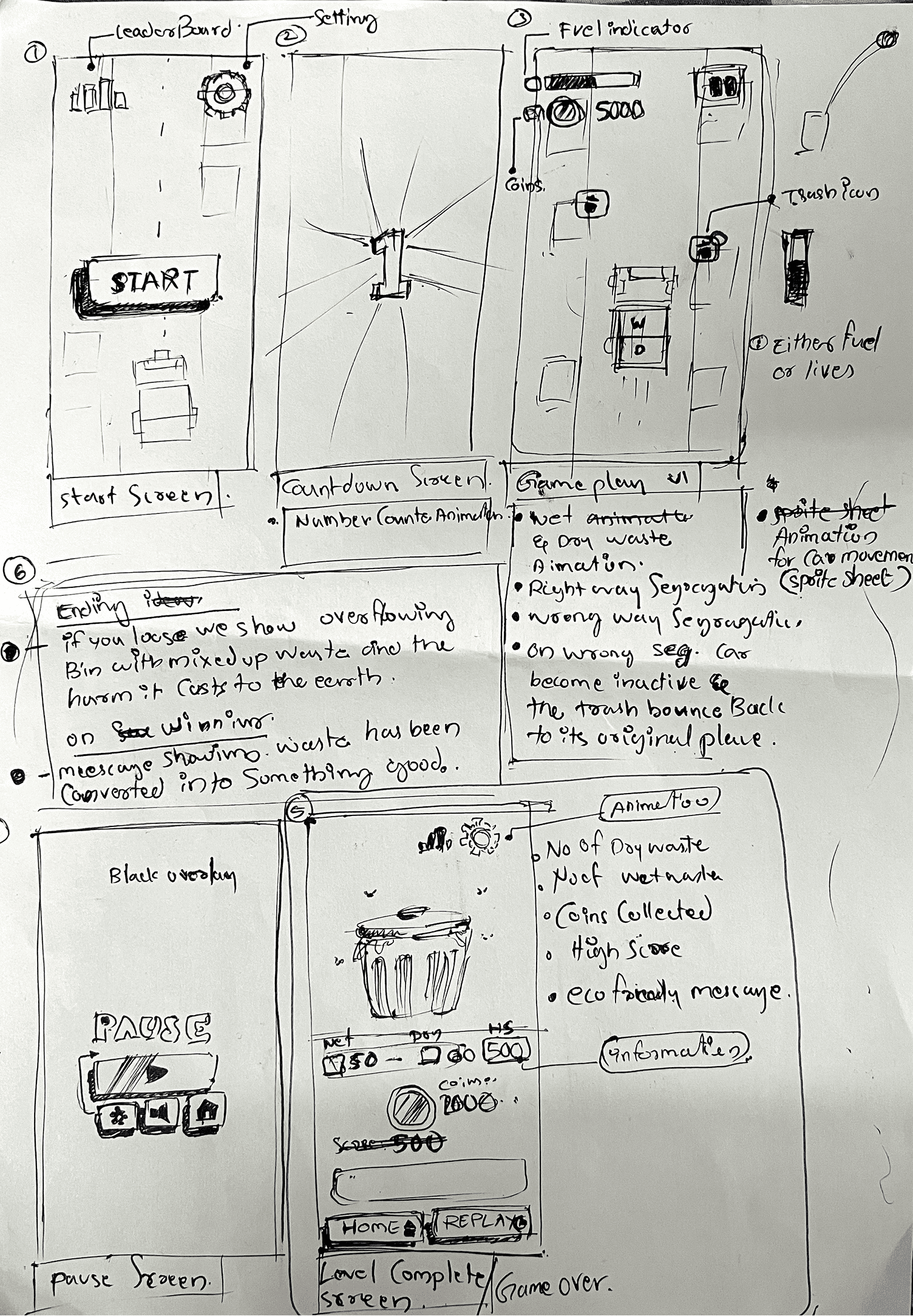
UX & Interaction design
The design focused on creating an intuitive learning curve while maintaining arcade-style excitement.
Key design decisions
1. Familiar Interaction Model
Players immediately understand sorting mechanics without tutorials.
2. Progressive Difficulty
Speed and waste volume increase gradually to maintain engagement.
3. Instant Feedback
Correct sorting > rewards and momentum
Mistakes > immediate correction signals
4. Learning Through Play
Instead of explaining sustainability, players experience its importance through gameplay actions.


Small, relatable ideas can create stronger impact than complex concepts.
Constraints accelerate clarity in decision-making.
Designing game mechanics is as critical as designing interfaces.
Sustainability experiences work best when embedded naturally into user actions.
If given more time, I would explore deeper progression systems and expanded feedback mechanics to enhance long-term engagement.