

Redseer reimagined. Strengthening brand visibility while building the foundation for a self-service consulting experience
Client:
Redseer Strategy Consultants
Product:
Enterprise Website
Role:
Senior Designer / Experience Design
Scope:
Brand Experience, UX Strategy, Information Architecture, Visual System, and Engagement Design
Duration:
Phase 1: Brand Revamp (2023), Phase 2: Strategic Redesign (2025)
Redseer and their objective
Redseer Strategy Consultants is a global strategy consulting firm helping digital-first and consumer-focused businesses grow through data-driven insights and market intelligence. Headquartered in Bengaluru, Redseer works with startups, enterprises, and investors across emerging markets. As the firm expanded its global presence, Redseer approached us to redesign their website to strengthen brand presence and improve visibility among their target audience.
A website that didn’t reflect the brand
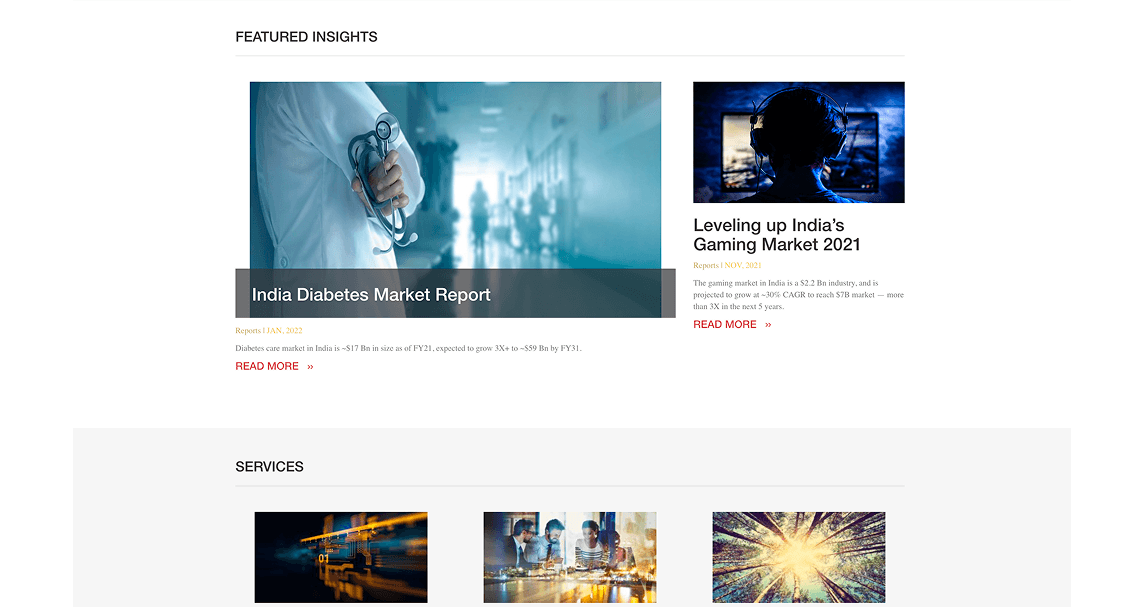

Website did not reflect Redseer’s brand identity
High visitor quit rate
No engagement hook
Generic consulting website experience
Content-heavy but experience-light
Visitors consumed information passively
The website existed to display information, not to create interaction.
Understanding what was missing
Lack of narrative structure
Weak brand recall
No emotional or intellectual entry point
Navigation driven by pages, not intent
No differentiated language system
Phase 1: Designing for brand authority
Objective
Create a strong, memorable digital brand presence.
Approach
Multiple brainstorming workshops
Aligning design with consulting credibility
Elevating visual confidence
Designing for recognition, not decoration
Strategic Direction
Strong typography
Editorial layout style
Insight-led storytelling
Brand-first hierarchy
Creating the “Red” ecosystem
We introduced a branded terminology system which reflected through several pages of redseer.


Why This Worked
Built brand language consistency
Increased memorability
Turned navigation into brand assets
Created intellectual ownership
Impact
Strong client adoption
Positive customer reception
Reinforced Redseer identity across touchpoints
Transition — Four years later
The continuity of the relationship with the client. A New Business Shift (2025). Requested by CEO Anil Kumar.
New strategic direction: “We Solve for New.”

New Goals
Help visitors find solutions independently
Reduce friction in discovery
Improve engagement quality
Align with new company strategy
Design Principles
Intent-driven navigation
Sector-first exploration
Clear problem–solution mapping
Faster cognitive understanding

Prominent visualization of solutions by sector.
Outcome
Faster comprehension
Increased relevant inquiries
Better audience segmentation
Design Principles
Intent-driven navigation
Sector-first exploration
Clear problem–solution mapping
Faster cognitive understanding

Increased visitor engagement
More focused customer queries
Better alignment with strategy
Stronger brand differentiation
Visitors understand value faster
Reduced informational friction
Website became an active business tool
Consulting websites often follow predictable patterns.
Differentiation comes from strategic storytelling.
Branding is not visual styling — it is language, structure, and interaction.
Long-term collaboration enables deeper design evolution.
The project felt deeply personal due to the long-term engagement, which allowed a strong sense of ownership and connection to develop over time. Stakeholders, Deepti and Vivek, actively enabled creative exploration, fostering an environment where ideas could evolve freely. This collaborative trust played a key role in driving meaningful and impactful outcomes. Ultimately, the design succeeded because both strategy and creativity were valued equally throughout the process.